
Federal Releases Linked to Austin County
The Federal Bureau of Prisons system is a jurisdictional path, not an Austin County facility. Research found no BOP prison in the county. A person arrested locally can enter federal custody if a federal court orders detention or if another authority transfers the person to the U.S. Marshals Service. That exit from Austin County Jail is a custodial transfer, not a community release.
BOP becomes the durable public search source after federal designation and for many former federal prisoners. Its locator generally covers federal inmates from 1982 to the present. The Austin County jail entry can establish when local control ended and name the receiving agency. The federal record then addresses the later federal status.
Confirm a Federal Prison Release
Use the exact federal identifier whenever possible. A BOP register number has eight digits in the format five digits, a hyphen, and three digits. The locator also accepts listed federal agency numbers. A name search uses first, middle, and last name with race, age, and sex filters.
- Open the official BOP Inmate Locator and choose number or name search.
- Enter the register number when known; otherwise use the full name and reliable filters.
- Compare the result’s name, register number, age, race, and sex.
- Read the displayed location or status and release date.
- Match the federal result to the court docket and Austin County transfer entry.
- Check another custodian only when the record identifies a later handoff.
A result showing “Released” or “Not in BOP Custody,” with no current federal facility, establishes only that BOP does not hold the person. It does not exclude federal supervised release, state custody, county custody, immigration detention, or confinement by a different sovereign.
The full named-person and local-record sequence appears on the Austin County released-inmate search page.
Federal Locator Result Fields
The official locator presents a compact record. Each field has a limited role:
| Field | What it supports |
|---|---|
| Name | Starts identity comparison but may not resolve a namesake. |
| Register number | Identifies the federal custody record. |
| Age, race, sex | Helps distinguish search results. |
| Location or status | Shows a current facility or a released/not-in-custody label. |
| Release date | Provides the date retained by BOP for the covered federal record. |
First Step Act recalculations can make a displayed release date stale. A locator date should therefore be read with the current status and confirmed through the federal case or responsible office when timing matters. The locator is not a promise about where the person went afterward.
BOP Locator Release Workflow
The official BOP Inmate Locator is the relevant successful manifest source for this page.
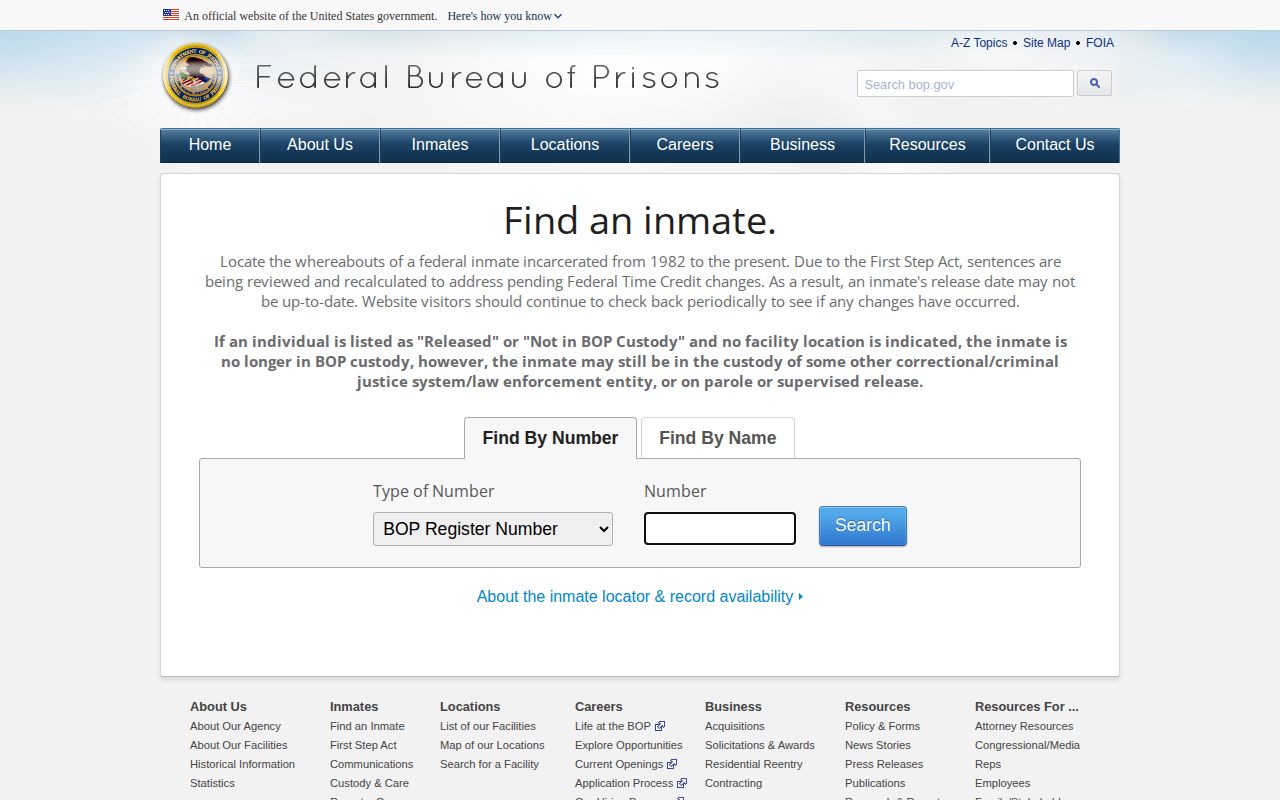
Use number search first because it limits false matches. If only a name is available, preserve every filter used and compare the result with the docket. Do not infer that a person with a similar name is the same defendant. A federal case number, register number, birth details, and transfer date form a much stronger chain.
When the BOP result is absent, the person may still be in pretrial Marshals custody, may predate the general coverage period, may have a data variation, or may never have entered BOP. The next step depends on the federal docket and custodian, not repeated guesses in the locator.
U.S. Marshals Transfer Records
The U.S. Marshals Service holds federal defendants from court-ordered custody until acquittal or conviction and delivery to BOP. It often uses contracted detention space. A person can therefore move from Austin County control to a facility outside the county without yet appearing as a designated BOP prisoner.
USMS does not offer a public historical released-inmate locator equivalent to BOP’s. It also generally does not disclose prisoner movement or photographs. Use the federal docket to trace orders and later use BOP when designation or a historical federal record exists. The official Marshals prisoner-operations page explains that federal custody role.
An Austin County entry reading transfer to USMS is not evidence of release to the community. Record the transfer time and receiving authority, then follow the federal court and custody path. This distinction prevents a local roster disappearance from being misread as freedom.
Federal Records and Contacts
There is no local BOP facility address or federal prison release desk to list in Austin County. The public point of access is the nationwide locator. The official Austin County jail page identifies the local custodian at 417 N. Chesley Street, Bellville, Texas 77418, and gives 979-865-5321.
Correct federal records route
Federal custody status: BOP Inmate Locator
Federal legal record: the court docket and clerk for the federal case
Pretrial transfer: U.S. Marshals and the federal docket
Local exit: Austin County Jail booking release or transfer entry
Ask Austin County for the exit date and time, release or transfer code, authority, and destination. The sheriff’s public-information page supplies the written-record route. The Austin County court portal can help match the local case. Those records cannot certify what occurred later in the federal system, while BOP’s locator cannot supply the Austin County jail-door time.
Federal Release Versus Supervision
Release from BOP incarceration does not necessarily end a federal sentence. A court may impose supervised release, which is a period in the community subject to federal court conditions and probation-office oversight. The BOP locator’s “Released” label is about BOP custody, not the completion of every legal obligation.
The federal judgment and docket are the sources for the sentence and any supervised-release term. A new case, violation, detainer, or transfer may also change where the person goes. Do not use a BOP status alone to rule out state or local custody.
Austin County release terms also remain separate. Bond, time served, dismissal, county sentence completion, TDCJ parole, and federal release come from different authorities. Match the agency on the record before interpreting the event.
Federal Release and ICE Holds
Research Section 19 highlights the local importance of immigration transfers. A person leaving BOP or local custody can be transferred to ICE when the facts support an immigration hold. That is not release to the community. Search ICE only after a record, attorney, or agency identifies that path.
ICE’s locator can retain a released detainee for a limited 60-day period, which differs from BOP’s longer historical scope. A BOP “Released” result and an ICE match can both be accurate because each describes a different custodian and point in time. The Austin County ICE detention guide explains the A-number search and that bounded window.
If there is no ICE match, do not reverse the inference. Spelling, age restrictions, timing, transfer, or delay can produce no result. Use the source record and official custodian contacts.
About the Federal Prison System
BOP operates federal prisons and community-corrections placements nationwide. It does not run Austin County Jail, and no BOP prison was located in Austin County during the research sweep. Federal defendants may spend time in contracted facilities under Marshals authority before BOP designation, so geography alone does not identify the governing record system.
A federal release inquiry is strongest when it joins three records: the Austin County transfer entry, the federal docket, and the BOP result. The first establishes local departure. The second shows legal authority. The third gives the federal location, status, or retained release date. None should be stretched beyond its jurisdiction.