
Austin County Projected Release Meaning
TDCJ defines a projected release date as an estimate based on the date when calendar time served plus applicable good-conduct time equals the sentence. Depending on legal eligibility, the displayed projection may point toward parole, mandatory supervision, or discharge. It is not the same as a scheduled release. A schedule generally appears only after release authority, planning, records review, and required conditions have advanced far enough for TDCJ to identify an intended event.
The actual release date is historical. It records when custody ended or changed. Parole eligibility is only the first point when the Board of Pardons and Paroles may consider release. Maximum expiration is the end calculated from the sentence, subject to lawful adjustments. Discharge can mean the sentence and supervision obligation have ended. These fields must be read separately.
A projected Austin County release date can move. Only the custodian's completed release entry proves the event and time.
Find Austin County Projected Dates
Choose the system from the sentence, not merely the arrest county. TDCJ does not calculate a bond release from Austin County Jail. Austin County does not calculate a later state-prison parole date after transfer to TDCJ.
- Confirm whether the person is awaiting trial, serving a county-jail term, or serving a TDCJ sentence. Use the Austin County case and booking number to avoid mixing custody episodes.
- For a state prisoner, open the TDCJ Information Search. Search by TDCJ number or SID when known, or by name with the displayed filters.
- Match the result through county, case number, offense, sentence date, and identifiers. Read projected release, parole eligibility, current location, and status as distinct fields.
- For a county sentence, contact Austin County Jail at 979-865-5321 and request the jail's calculation and actual release entry. Compare it with the judgment held by the correct clerk.
- For a pending case, review the court docket and bond or release order. Do not invent a date when no order or fixed sentence supplies one.
TDCJ also accepts inmate-information questions by phone at 936-295-6371 or 800-535-0283 on weekdays from 8 a.m. to 5 p.m. Its basic email lookup can use the person's full name, TDCJ number, date of birth, and county of conviction. Online information may lag, and the reply is not a certified release record.
Identity checks matter because common names can return more than one person. A matching Austin County conviction is useful, but it should be paired with date of birth, SID or TDCJ number, sentence date, offense, and case number. A person can also have sentences from more than one county. In that event, the controlling date may reflect the combined state record rather than the Austin County case viewed alone. If the online result lacks a projected field or displays “N/A,” do not calculate a substitute. Ask TDCJ which field is currently available and whether another sentence, status, or legal rule controls the record.
The official offender-search page shows where the state lookup starts:
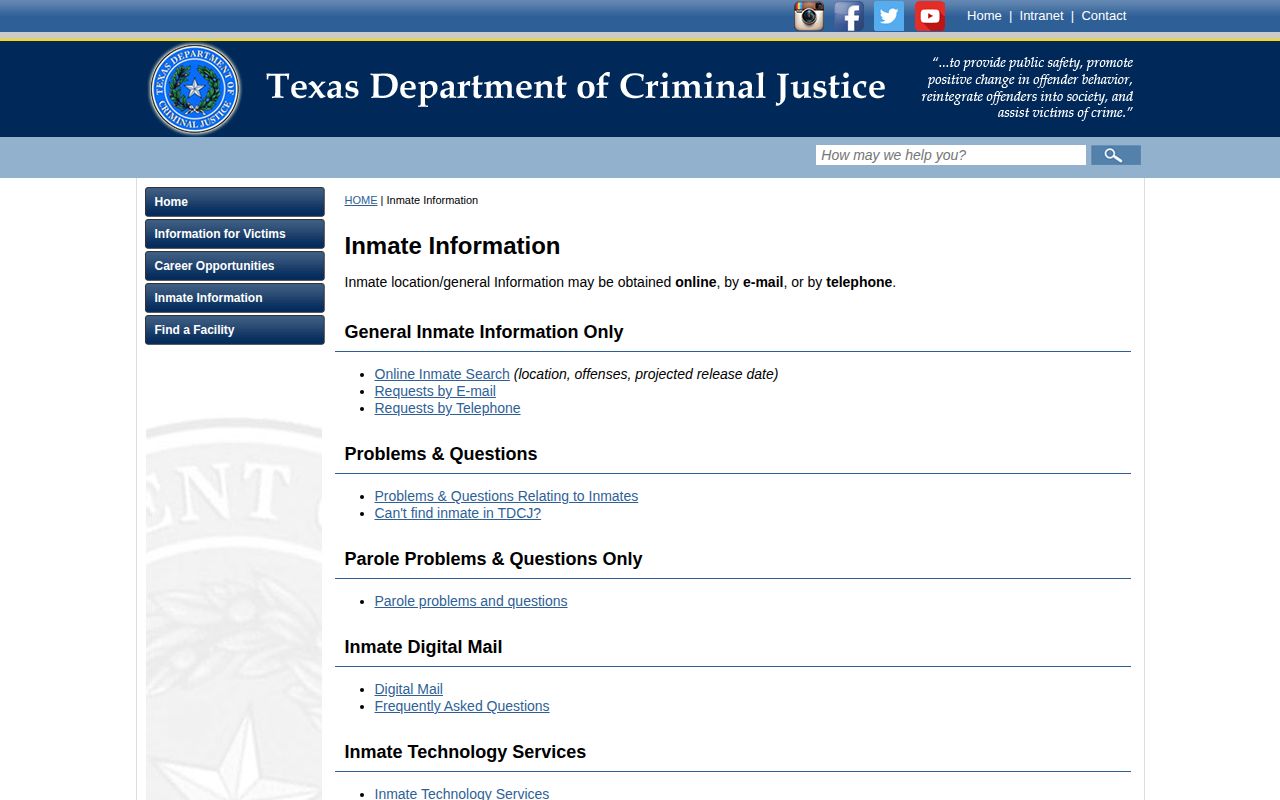
The result must still be matched to the correct sentence and person.
Texas Good Time and Release
Texas Government Code section 498.003 makes good-conduct time a privilege, not a right. It affects eligibility for parole or mandatory supervision and does not otherwise shorten the sentence itself. Accrual depends on classification. The statute includes twenty days per thirty days actually served for trusty and Class I status, ten per thirty for Class II, and none for Class III or while on parole or mandatory supervision. Certain diligent program participation can add credit. Disciplinary violations can cause forfeiture under section 498.004.
Classification and credits are only part of the calculation. Government Code section 508.145 gives the general parole-eligibility formula, subject to many categories. In the general rule, calendar time plus awarded good time must equal one-fourth of the sentence or fifteen years, whichever is less. That is eligibility for board review, not a release date.
For specified serious offenses and qualifying deadly-weapon findings, actual calendar time without good time generally must reach one-half of the sentence or thirty years, whichever is less, with a minimum of two calendar years. Other offenses have separate rules. Texas has no blanket rule that every TDCJ prisoner must serve eighty-five percent. A generic percentage calculator can therefore give a false answer.
Austin County Mandatory Supervision Dates
Mandatory supervision is another possible release route, but its name can mislead. Section 508.147 generally compares calendar time plus accrued good time with the sentence. Section 508.149 lists broad exclusions and permits the Board to deny discretionary mandatory supervision in covered cases when it makes the required findings. The decision is not a simple violent-versus-nonviolent split.
Parole approval can also carry a residence plan, program placement, or special condition. Approval does not mean release that day. TDCJ Classification and Records must complete its work, and the Parole Division must be ready to supervise the approved plan. A decision may later be reconsidered if circumstances change.
- Eligibility
- The first lawful point for review.
- Projection
- A calculated estimate using current record data.
- Schedule
- A planned event after required approvals and processing.
- Actual release
- The completed custody exit recorded by the custodian.
Why Austin County Release Dates Move
A date can change for legal, disciplinary, or administrative reasons. Compare the newest state result with the controlling judgment and any other active case.
| Factor | Possible effect |
|---|---|
| Credit accrual | Changes an eligibility or projection calculation |
| Forfeiture or restoration | Moves credit-dependent dates after discipline or review |
| Sentence or jail-credit correction | Changes the base calculation |
| New detainer or hold | May prevent community release or send the person to another custodian |
| BPP decision | Approval, denial, or later review alters the expected path |
| Program or residence plan | Can delay an approved release until requirements are satisfied |
| Records audit | Corrects a date after Classification and Records review |
A court can issue an order before physical release processing ends. Jail staff may still need to verify holds, paperwork, property, and transfer conditions. Therefore, the order time and the jail exit time can differ without either record being false.
Another case can change the destination without changing the fact that one sentence reached its expected point. A county warrant, federal detainer, immigration detainer, or commitment in a different jurisdiction may cause transfer at the end of TDCJ or local custody. Read the destination field and receiving agency. The first custodian's “release” may mean release from that agency only. It does not establish that all legal restraint ended.
Austin County Jail Good Time
County-jail good time is not the TDCJ calculation. Texas Code of Criminal Procedure article 42.032 allows a sheriff to grant commutation for good conduct, industry, and obedience, up to one day for each day actually served. The law uses “may.” It also permits forfeiture for misconduct and contains restrictions tied to fines and costs.
Austin County's actual practice, a person's conduct, judicial credit, active holds, and the release order cannot be derived from the largest statutory credit. Ask the jail for its calculation and completed release entry. Do not apply TDCJ class rates to a county sentence, and do not assume the maximum county credit was awarded.
Can a maximum statutory credit predict the door date? No. It states what may be possible under the law, not what Austin County recorded for one person.
Confirm Austin County Actual Release
For county custody, Texas IVSS-Counties can provide a status-change alert while the person remains covered by the participating feed. Search by name or ID, match the Austin County agency, and register for available phone, email, or text events. A notification may lag the jail's internal event while data transmits. A transfer alert is not community release, and disappearance from the portal proves nothing by itself.
TDCJ custody and parole notifications use a separate IVSS system. Before a release vote, the Board status line is 844-512-0461. After approval, the Parole Division release-status number is 512-406-5202. Those channels answer different stages. The Austin County VINE inmate check explains the county and state portal split.
After the event, obtain the Austin County jail entry or updated TDCJ status. Record the time, type, authority, and destination. If another agency took custody, continue with that system instead of labeling the first exit a completed release.
For a court-based check, misdemeanor files are routed through the Austin County Clerk, while indicted felony records belong with the District Clerk and 155th District Court. A judgment provides the sentence and credit language; later docket entries may show a correction, bond action, dismissal, or other order. The clerk does not certify the moment jail staff completed release. Use the court record for authority and the jail or TDCJ record for the physical event.