
Austin County Parole Versus Probation
Parole and probation are not interchangeable. The Texas Board of Pardons and Paroles decides whether an eligible state prisoner may leave prison on parole or mandatory supervision. The TDCJ Parole Division then supervises that person in the community. Probation, formally called community supervision in Texas, comes from a sentencing court and is administered by a local Community Supervision and Corrections Department, or CSCD. A probationer may have served a short jail term, but may never have entered TDCJ.
Neither label proves the exact time a person left Austin County Jail. The jail release entry establishes the physical exit or transfer. The court record explains the order, sentence, or revocation. TDCJ and the local CSCD establish supervision after that event. These records should be read together when the status matters.
| Question | Parole | Probation |
|---|---|---|
| Who orders it? | Texas Board of Pardons and Paroles after a TDCJ sentence | The sentencing court |
| Who supervises it? | TDCJ Parole Division | Austin, Fayette and Waller CSCD |
| Was state prison required? | Yes, parole follows state incarceration | No, probation may replace or follow local confinement |
| Best verification path | TDCJ record, BPP status, Parole Division and assigned district office | Sentencing court and local adult CSCD |
| How does it end? | Discharge, revocation, or other formal agency action | Completion, court modification, discharge, or revocation |
Austin County Supervision Terms
Texas records use short terms that can obscure major differences. Read the status and the responsible agency before drawing a conclusion. A release from confinement is not always the end of legal custody.
- Parole
- Conditional release from TDCJ incarceration while the sentence continues under supervision.
- Mandatory supervision
- A form of supervised release governed by sentence credits, offense rules, and in many cases a BPP decision.
- Community supervision
- The Texas statutory term commonly called adult probation, administered under a court order.
- Absconder
- A person an agency alleges has stopped reporting or cannot be located as required. The label should be confirmed with the supervising agency.
- Discharge
- Formal completion of a sentence or supervision term, distinct from the earlier date confinement ended.
Check Austin County Supervision Status
Start with the known court case or custody record. A name alone can match the wrong person. Use a date of birth, case number, SID number, or TDCJ number whenever the agency accepts it. The correct path depends on whether the person left Austin County Jail, a Texas prison, or a local court sentence.
- Identify the source case. Search the Austin County court portal and match the defendant, charge, case number, judgment, and later docket events.
- Check TDCJ when state prison is involved. Use the official TDCJ Information Search for the facility or status, projected date, parole eligibility field, and parole-review link.
- Separate a vote from release. Before a board vote, call the BPP status line at 844-512-0461. After an approved vote, use the Parole Division release-status line at 512-406-5202.
- Confirm the reporting office. Austin County parole cases route through the Rosenberg District Parole Office. Ask the office to verify the proper reporting location, subject to disclosure limits.
- Use the local court path for probation. Contact the Austin County adult CSCD unit and the sentencing clerk for completion, modification, or revocation information.
- Request a record when needed. Send parole public-information requests to pia@tdcj.texas.gov. Obtain probation orders and docket entries through the correct Austin County clerk.
Note: A favorable parole vote is not the same event as release from a TDCJ unit.
Austin County Release Office Routing
Austin County has no single supervision counter. State parole is assigned to Region III through the Rosenberg District Parole Office. Adult probation belongs to a three-county judicial-district CSCD, with an Austin County unit in Bellville. The Texas Board of Pardons and Paroles controls parole decisions, while TDCJ Parole Division handles supervision and post-vote release status.
Rosenberg District Parole Office, Region III
711 Highway 36 North
Rosenberg, TX 77471
281-232-0334
Austin County Adult CSCD
265 N. Chesley Street, Suite 6
Bellville, TX 77418
979-865-5656
TDCJ Parole Division
8610 Shoal Creek Boulevard
Austin, TX 78711
512-406-5250
io@tdcj.texas.gov
Use the TDCJ email contact for questions about a parolee’s location or conduct and include a full name plus a TDCJ number, SID, or date of birth. Public records follow the separate TDCJ public-information channel. For probation, the CSCD and sentencing court are the reliable local sources because no supported public statewide probationer name search was found.
Which Austin County Supervision Office?
The county-specific split prevents a common routing error. Rosenberg DPO handles state parole for Austin County. The Bellville CSCD unit handles adult probation for Austin, Fayette, and Waller counties. A county page labeled “probation” concerns juvenile probation and should not be used to look for adult supervision records. Juvenile information is restricted.
The official TDCJ CJAD directory shows the local community-supervision routing. This is Angle R from the Austin County research: three agencies may use similar supervision terms, but their authority, records, and people differ. Call the office tied to the judgment or TDCJ release, not the office whose title merely sounds closest.
The successful directory capture shows how Texas organizes local adult supervision.
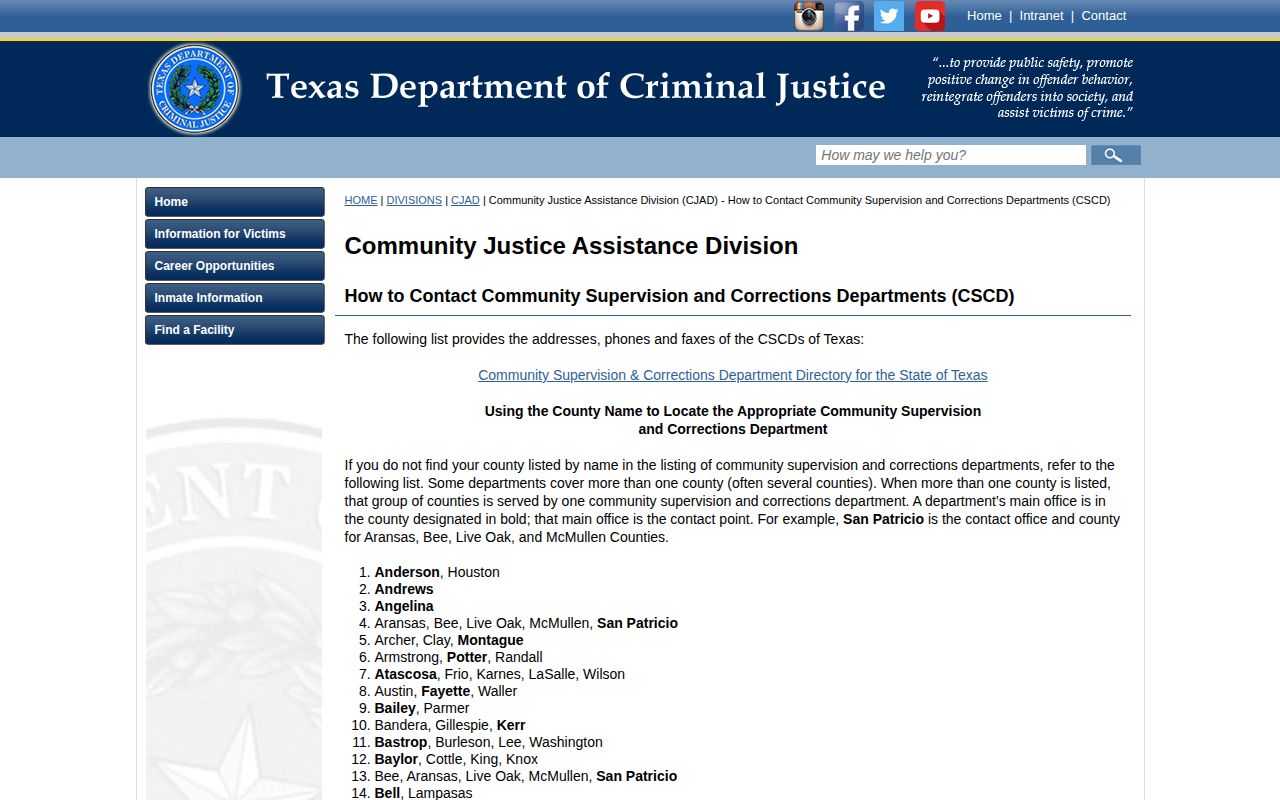
The directory confirms why an Austin County adult probation question belongs with the Bellville CSCD unit rather than the state parole office.
Austin County Parole Notifications
Texas runs separate notification systems for county and state custody. Texas IVSS-Counties covers participating county jail and court events. TDCJ maintains a different IVSS portal for prison custody, parole, and mandatory-supervision notices. Registration in one system should not be assumed to carry into the other. Austin County’s county participation is backed by the state grant record and county contract action, but a state-prison case still belongs in the TDCJ portal.
The TDCJ IVSS portal is the state source for prison and parole notifications, with help available at 800-848-4284. Alerts are useful status leads. They do not replace the release entry, supervision record, or court order, and transmission can lag an agency event.
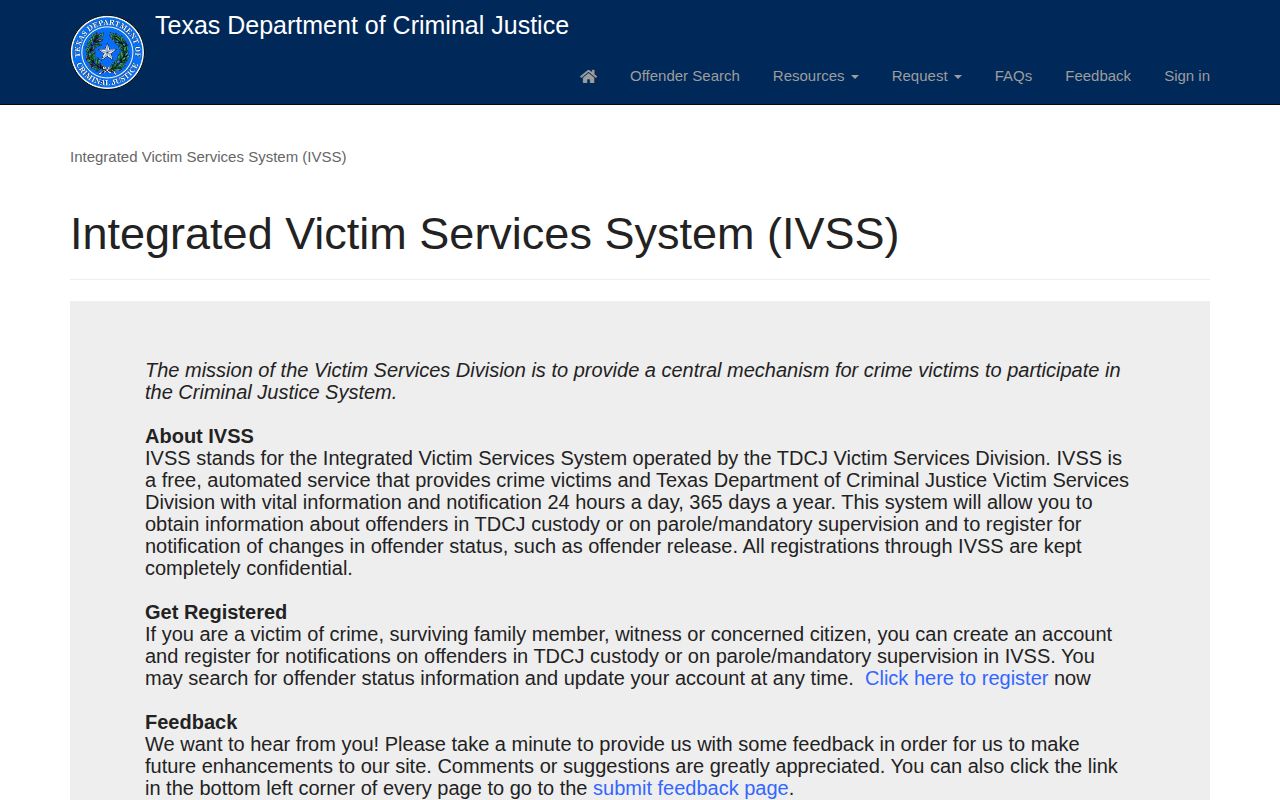
This screen belongs to TDCJ matters, not an ordinary Austin County bond release or local probation order.
Austin County Supervision Warrants
A warrant or absconder entry can show that an agency seeks custody after a prior release. It does not undo the earlier release record. Nor does a generic warrant page prove a parole or probation violation. The Austin County Sheriff’s warrant page is only a lead. Confirm a parole warrant with TDCJ Parole Division or BPP. Confirm a probation warrant through the CSCD and sentencing court.
Conditions can include reporting, approved residence, travel limits, program participation, or other terms in the person’s order. A claimed breach may lead to review, a warrant, a hearing, modification, or revocation. The exact condition and agency action must come from the official record. Avoid labeling a person an absconder from an old or incomplete entry.
Austin County Release Property Records
Supervision questions often arise while a person is also trying to recover identification or property left with the jail. Austin County Sheriff’s Office links a property-release form and sends completed forms to property@austincountyso.org. That property process is separate from Rosenberg parole reporting and the Bellville CSCD. Contacting the supervision office will not replace the sheriff’s property procedure.
Angle H adds a durable records point. Texas Local Schedule PS sets a minimum retention of release or transfer plus two years for booking-in/out, transfer and release orders, and prisoner property inventory or return records. Medical release or transfer records have a seven-year minimum. Expunction, litigation holds, and other law may alter normal retention. A missing web result therefore does not show that the Austin County source record is gone.
For the original exit event and property trail, use the sheriff’s public-information process described in the Austin County released inmate search. For supervision, stay with TDCJ, BPP, the CSCD, and the sentencing court.
Austin County Supervision Discharge
Release from a jail or prison and discharge from supervision are separate milestones. Parole and mandatory supervision let a person live in the community while legal supervision continues. TDCJ defines discharge as completion of the sentence and release from incarceration, parole, mandatory supervision, or community supervision. A projected or scheduled release date is not a discharge date.
Probation can end through completion or a formal court action. It may also be modified or revoked. Verify the end of Austin County probation with the CSCD and sentencing court. Verify a state parole discharge through TDCJ records. A later discharge does not change the jail’s historical booking and release event, though expunction or nondisclosure law can restrict access to eligible records through a distinct legal process.