
TDCJ Release Paths for Austin County
No TDCJ prison is listed in Austin County. The department is still relevant when an Austin County court commits a convicted person to state prison. The person may be assigned to any suitable unit in the statewide system. Movement from Austin County Jail to TDCJ is a transfer between custodians, not a return to the community. The county release entry should name TDCJ or the receiving authority, and the later state record controls the prison release.
A person can leave incarceration on parole, mandatory supervision, or at the end of the custodial term. Parole is a conditional community release approved by the Texas Board of Pardons and Paroles. Mandatory supervision is a statutory release process that also leaves supervision in force and may require board approval. Discharge means the sentence has ended, including any applicable supervision. These outcomes should not be collapsed into one label.
| TDCJ event | Custody meaning | Best evidence |
|---|---|---|
| County transfer to TDCJ | State imprisonment begins or continues | County exit record and TDCJ location |
| Parole | Community release under conditions | TDCJ status and Parole Division record |
| Mandatory supervision | Community release with supervision | TDCJ detail and board action |
| Discharge | Sentence and supervision end | TDCJ discharge record |
Confirm a TDCJ Release Record
The official TDCJ Information Search is the first statewide check. It accepts last name, first name, TDCJ number, State Identification number, gender, and race. A TDCJ or SID number is safer than a name alone. Match the county and court of conviction, offense, sentence, and date of birth before treating a result as the right person.
- Search the seven-digit TDCJ number or SID when available. Otherwise combine the name with reliable identifiers.
- Open the matching detail and note the current unit or status, conviction county, offense, sentence, parole eligibility date, and projected release date.
- Review the linked Parole Review Information. A favorable board vote does not prove that physical release occurred.
- Before a release vote, call the BPP status line at 844-512-0461. After approval, call the Parole Division release-status line at 512-406-5202.
- Reconcile the state result with the Austin County court judgment and the county jail transfer record.
A county-only case belongs on a different path. Someone who posted bond, completed a short Austin County sentence, or received a local dismissal may never enter TDCJ. The Austin County released inmate search explains the local jail, court, and records-request routes.
TDCJ Release Dates and Status
The search detail can display location or status, offense, county and court of conviction, sentence date and length, parole eligibility, projected release, and parole-review information. Each field answers a separate question. Parole eligibility is the first point at which a case may be reviewed under the governing law. It is not a promise of parole. A projected release date estimates release from incarceration if parole does not occur sooner. A scheduled release reflects a more developed plan, yet it can still move.
- Projected release
- A date calculated by TDCJ Classification and Records from the sentence, offense, offense date, and applicable credit rules.
- Scheduled release
- A planned date and sometimes location after required release steps, still subject to change.
- Parole
- Conditional release to the community while the sentence and supervision continue.
- Discharge
- Completion of incarceration and any parole, mandatory supervision, or community supervision tied to the sentence.
Classification and Records audits the calculation after an approved release certificate arrives. TDCJ guidance describes a common audit period of about 14 to 21 business days. Required programs and an approved residence can lengthen the broader process. Those ranges are agency guidance, not fixed deadlines for an Austin County case.
Request Written TDCJ Release Records
When the online detail is incomplete or historical, use TDCJ’s written information channel. Send the full name and TDCJ number to pia@tdcj.texas.gov. If the number is unknown, provide the exact date of birth, or an approximate age and county of conviction, and place the person’s name in the subject line. TDCJ states that this no-charge channel may provide the number, location, conviction offense, prior or current incarceration information, and projected release date. It does not provide photographs or Social Security numbers through this service.
Texas Department of Criminal JusticeStatewide correctional institution system
Location information: 936-295-6371 or 800-535-0283
Monday through Friday, 8 a.m. to 5 p.m.
Written information: pia@tdcj.texas.gov
Ask for the existing release, discharge, or supervision record needed to resolve the question. Include the Austin County conviction and case number when known. For a completed event, seek the actual release date and status rather than relying only on an earlier projection.
TDCJ Units Serving Austin County Cases
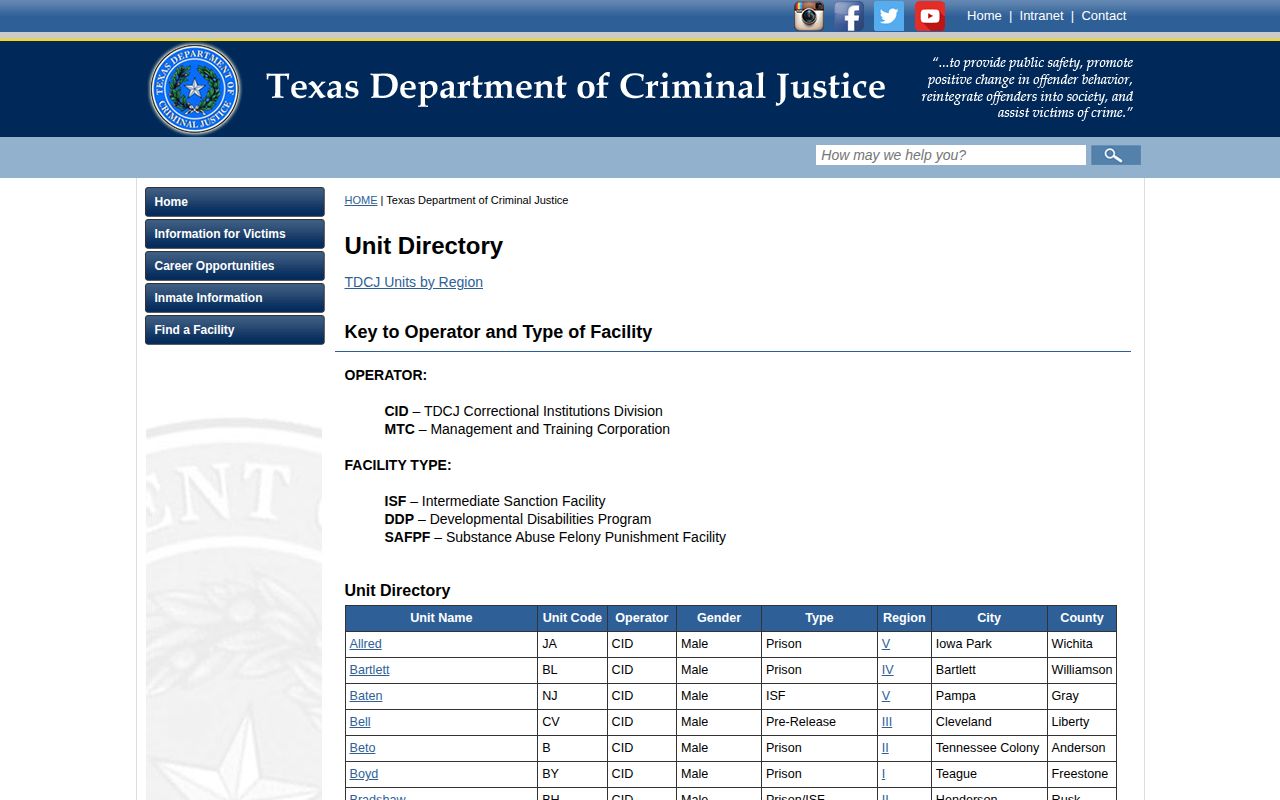
TDCJ operates correctional institutions across Texas, but its official unit directory identifies no state prison in Austin County. A local conviction therefore does not predict the unit of assignment or release location. Classification needs, transfers, programs, medical needs, and release planning can place a person elsewhere in the state.
The directory screenshot below documents the statewide unit structure that must be searched instead of assuming a nearby Austin County prison.
Use the person-specific TDCJ result for the current unit. Before traveling for pickup, call that unit. The department expressly advises relatives to confirm because release details can change.
TDCJ Release Processing and Parole
Release from a state institution involves more than a board vote. The Board of Pardons and Paroles makes the parole decision, while TDCJ Classification and Records verifies the sentence calculation. The Parole Division handles post-release status and supervision. A case can also depend on program completion and an approved residence plan. The separate offices explain why an approved decision and a gate exit may occur on different dates.
The TDCJ release-process information outlines how offenders leave state custody. Its captured page is shown below.
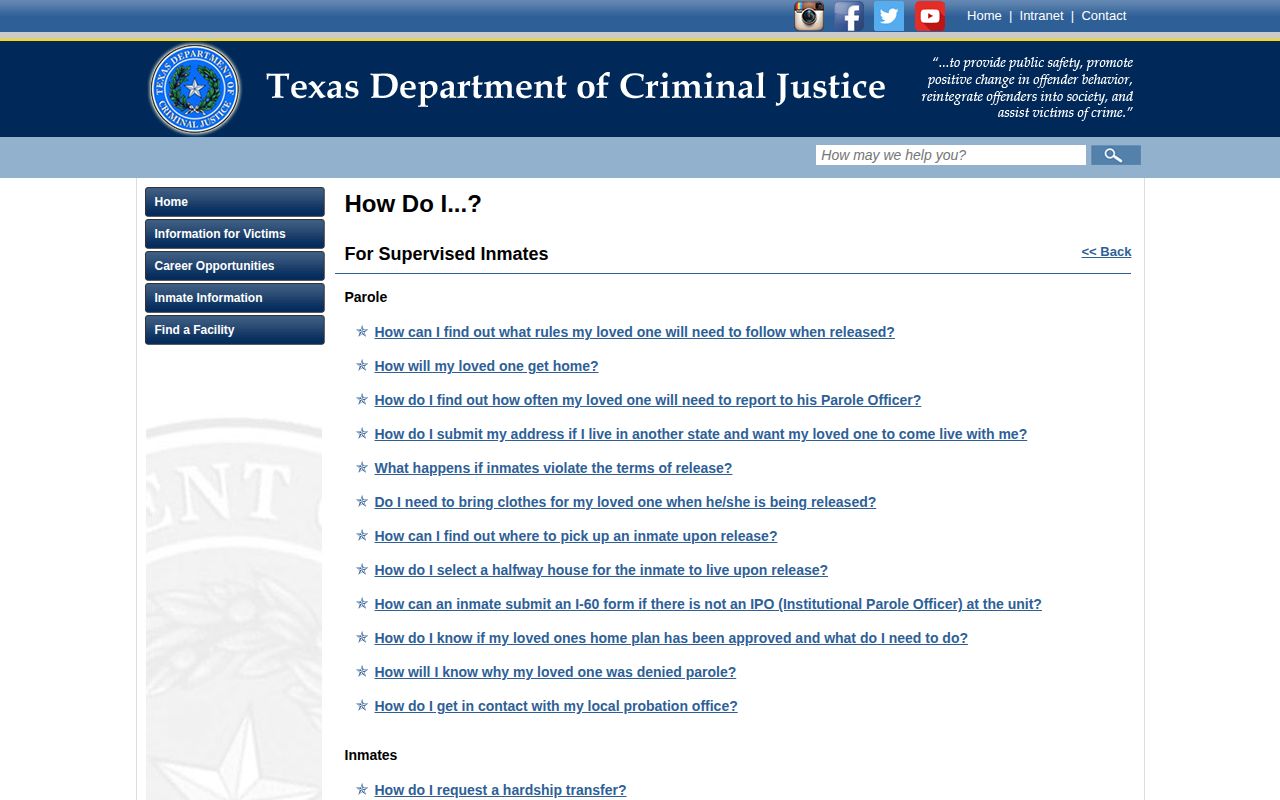
The process image supports a crucial Austin County distinction: the sheriff documents the transfer into state custody, but TDCJ and the parole authorities document the later state release. For notification of TDCJ custody and parole events, use the separate TDCJ IVSS portal or call Victim Services at 800-848-4284. County IVSS-Counties is a different service for participating jail and court events.
TDCJ Parole Records After Release
A state-prison exit can begin a new record trail. TDCJ Parole Division supervises people released on parole or mandatory supervision, while the Board of Pardons and Paroles makes release decisions. Austin County is routed through the Rosenberg District Parole Office at 711 Highway 36 North, Rosenberg, Texas 77471, telephone 281-232-0334. That office route is different from Austin County adult probation, which is administered by the multi-county judicial-district CSCD in Bellville.
The official TDCJ Parole Division page describes the statewide supervision function. The source image below helps identify the correct agency after a TDCJ release.
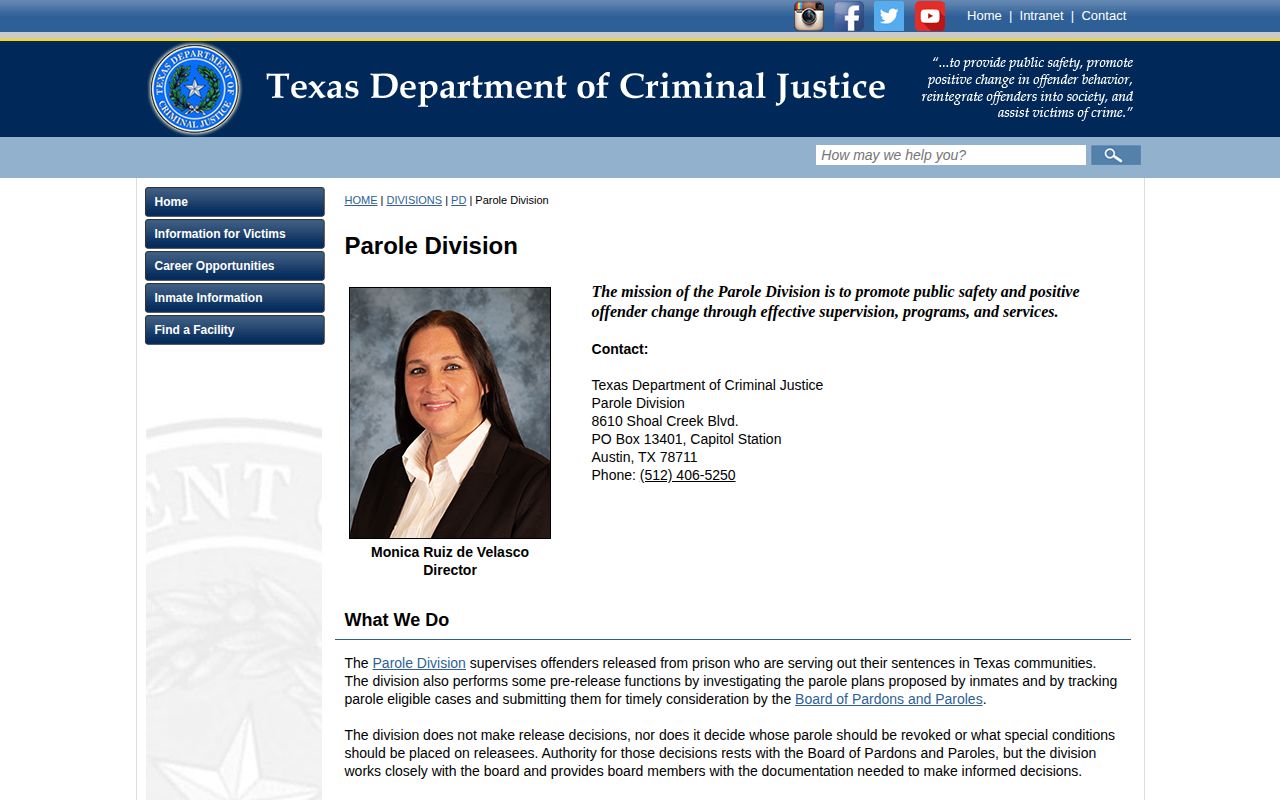
Parole status means the person has left prison but remains under legal supervision. It does not mean the sentence was discharged. Call the release-status line after a favorable board vote, then use the district office route for supervision questions. A denial usually includes a later review setting, while an approval may include conditions or pre-release requirements. Neither a next-review date nor approval alone is an actual release timestamp.
Austin County ICE Transfer After TDCJ
An immigration hold can affect the meaning of a release from prison. If TDCJ transfers a person to ICE, the state confinement may end while federal civil detention begins. That is not an ordinary community release. Use the TDCJ record to establish the state exit, then use the ICE Online Detainee Locator only when immigration custody is supported by the facts.
ICE’s locator can retain information for a released detainee for 60 days. A nine-digit A-number plus country of birth is the strongest search route. A missing result does not prove freedom because spelling, age rules, brief custody, transfers, and data delay can affect the display. The receiving authority named in the TDCJ record remains key.
Austin County Jail Is Not TDCJ
Two local facts help prevent wrong-system searches. The operating Austin County Jail is on North Chesley Street, while the historic Jail Museum is on South Bell Street. Neither is a TDCJ prison. The museum cannot answer custody questions, and the county jail cannot certify a later state discharge. Each office controls its own event record.
Austin County also temporarily houses female inmates through Fort Bend County. A woman can leave the local building for Fort Bend without entering TDCJ and without returning to the community. Confirm the Austin County handoff first. Search TDCJ only when the judgment or receiving record shows a state commitment. This avoids treating every county-jail disappearance as either state imprisonment or release.
Read TDCJ Release Evidence Carefully
The strongest record depends on the event. An Austin County jail exit record proves the local transfer. A certified judgment shows the sentence. TDCJ establishes state location, release, parole, mandatory supervision, or discharge. BPP information explains parole review, and the Parole Division confirms release status after approval. Compare those sources rather than drawing a conclusion from one missing name.
Identity also matters. Names can match, records can lag, and restricted or corrected material may not appear publicly. Use the TDCJ or SID number when possible, then compare the county, court, offense, and sentence. An arrest or booking does not establish guilt. A former state prisoner can be in the community under supervision even though incarceration ended, while a fully discharged person has completed the sentence.